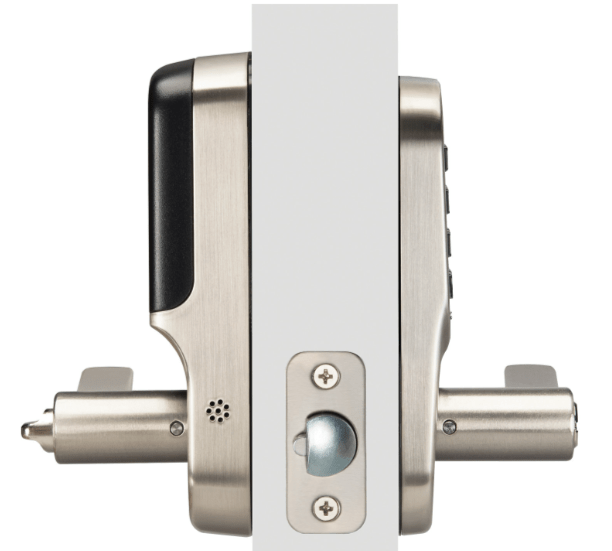
The Yale Pro 2 Lever: A Buyer’s Guide for Every Kind of Property Owner
The Yale Pro 2 comes in more than one form factor, and the lever version (the Augusta Lever cylindrical lock, sold as the YMB614 pushbutton and YMB624 touchscreen) solves a different problem than the deadbolt. Instead of a twist-knob deadbolt for a main entry door, it’s a single-hole-prep lever lock — the kind of hardware you’d find on a gym door, mailroom, laundry room, gate, or interior office door. Here’s what it offers, and how it plays out for different kinds of property owners.
What’s in the box: the core features
- Single-hole-prep lever design — installs into the same bore as a standard commercial lever handle, no additional holes or hardwiring required.
- Keyed or key-free models — the YMB614 (pushbutton) and YMB624 (touchscreen) are available with a traditional key backup or fully keyless.
- ADA-friendly lever handle — easier to operate one-handed or with limited grip strength than a twisting deadbolt knob, which matters for shared and commercial spaces.
- Bluetooth built-in, with swappable modules — add Wi-Fi, Z-Wave Plus, or Zigbee later via a plug-in smart module, no need to replace the lock.
- DoorSense — sends an alert if the door hasn’t fully closed, useful for doors that get heavy foot traffic.
- Commercial-grade durability — ANSI/BHMA Grade 1 certified (a step above the Grade 2 rating on most residential deadbolts), with a rubber gasket and IPX5-rated keypad for outdoor or semi-exposed installs.
- Backup power — a 9V battery terminal lets you jump-start the lock if the 6 AA batteries die, so nobody gets locked out.
Now, here’s how those features apply depending on who’s buying.
For Property Managers
The lever’s single-hole prep is exactly what makes it useful across a property: gyms, mailrooms, laundry rooms, pool gates, and shared storage all typically use lever hardware rather than deadbolts, and the Pro 2 Lever drops into that same prep without any carpentry. That means you can standardize access control across every shared space in a building, not just individual unit doors — one Yale Access ecosystem, one code system, one activity log.
The Grade 1 commercial rating also matters here: it’s built for the traffic level of shared amenity spaces rather than a single household’s front door. And because codes can be issued and revoked centrally once a Wi-Fi or Z-Wave module is installed, you can restrict amenity access by unit, by lease term, or by time of day without handing out physical keys that get copied or lost.
Bottom line: a commercial-grade, code-managed lever for every shared door in the building, tied into the same system as your unit-level deadbolts.
For Airbnb and Short-Term Rental Hosts
If your rental has anything beyond a single front door — a gated side entrance, a laundry room, a storage closet for extra towels and linens, a shed, or an ADU — the lever version lets you extend the same code-based access to those secondary points. Instead of leaving a spare key hidden outside (never a great look for a rental), you can give guests a temporary code to the gate or the laundry room that expires automatically at checkout, right alongside the code for the front door.
DoorSense is a nice safety net here too: gates and side doors are exactly the kind of thing a guest might not realize didn’t latch behind them.
Bottom line: extends the same guest-code convenience from your front door to gates, storage, and secondary access points on the property.
For Condo Owners
This is where the lever really shines, because it’s built for exactly the doors an HOA controls: the gym, the mail room, the pool gate, the parcel room, the shared laundry. Because it uses a standard single-hole lever prep, it typically drops into existing commercial hardware without modification — a much easier sell to an HOA board than swapping a whole door or frame.
If your condo association is deciding how to modernize keyed access to shared amenities, the Pro 2 Lever’s ADA-compliant handle is also worth flagging: it’s easier and safer for residents with limited hand mobility than a twist-lock or push-pull mechanism, which can matter for compliance with accessibility requirements in common areas.
Bottom line: a natural fit for shared amenity doors condo boards are already responsible for maintaining, with an accessible handle design built in.
For First-Time Homebuyers
For a typical single-family front door, you’ll usually want the Pro 2 deadbolt rather than the lever — but the lever has a place in a first home too, especially if your property has a side gate, a detached garage, a shed, or an interior door (like an office or storage room) where you want code-based access without carrying a key. It’s also common on townhomes and multi-unit buildings where a lever handle, not a deadbolt, is the standard hardware on a shared entrance.
If you’re buying into that kind of property, knowing the difference matters: check which style of lock your entry point actually uses before assuming you need the deadbolt version.
Bottom line: less common for a standalone house’s front door, but the right choice for gates, sheds, interior doors, or any entrance built around lever hardware.
For Florida Homeowners: A Word on Insurance Discounts
Insurance discounts for protective devices generally focus on exterior entry doors — deadbolts, in particular, are the device most commonly named on insurer discount lists, alongside burglar and fire alarm systems. A lever lock used on an interior door, gate, or amenity space typically won’t factor into a homeowner’s policy discount the way a deadbolt on the main entrance would, since it’s not usually the “line of defense” insurers are evaluating.
That said, if the Pro 2 Lever is installed as the primary lock on an exterior entry door at your property, it’s still worth asking your insurance agent whether it qualifies under their protective-device criteria — policies and definitions vary by carrier, and it costs nothing to ask.
Bottom line: don’t expect an insurance discount for lever locks on interior or amenity doors, but check with your agent if it’s on an exterior entrance.
Putting It Together
The Pro 2 Lever isn’t a replacement for the deadbolt — it’s the answer to a different question. Wherever a property has lever-style hardware rather than a deadbolt (gyms, mailrooms, gates, interior doors, shared amenities), this is the piece that brings the same code management, activity logging, and swappable connectivity to those doors too. For most property types, the deadbolt and the lever end up working side by side, covering the front door and everything else respectively.